


Your Malaga Host

Mid-term rentals in Malaga are rentals of more than 31 days, and as a general rule less than twelve months, to a tenant who is away from home for a justified reason: work, studies, medical treatment or building works at their own home.
In Spain they are called alquiler de temporada. They don’t need a tourist licence. But since 8 October 2026 they have new, stricter rules.
Many owners are looking at them for a very specific reason: Malaga city has not granted new tourist rental licences since August 2025. If you don’t have a licence, a mid-term rental looks like the natural way out.
Sometimes it is. Other times it earns far less than the same property would as a holiday let. This guide explains what has changed, what you need to do it properly and how to decide with real numbers.
It is the rental of a furnished home to someone who needs it for a limited time because they are temporarily away from their usual home.
Typical examples in Malaga: the engineer on a six-month project at the Technology Park, the student doing a master’s degree, the family waiting for the renovation of their own home to finish, or the professional covering a post at a hospital.
How it differs from the other two types of rental:
That last difference is what makes mid-term rentals attractive to many owners. And it is exactly what the law has now set out to protect.

Royal Decree-law 29/2026 of 6 October, published in the BOE on 7 October and in force since the 8th, rewrote the Spanish Urban Leases Act (LAU) for mid-term rentals. Congress ratified it on 12 November 2026, so it is now final.
The core change: a mid-term rental is no longer a lease for «use other than housing». It is now a temporary housing lease, with its own rules.
| Aspect | Before 8 Oct 2026 | Now |
|---|---|---|
| Duration | Freely agreed | More than 31 days and, as a general rule, no more than 12 months |
| Reason for the temporary stay | Recommended | Compulsory in the contract, genuine and provable |
| Who must prove it | Not regulated | The landlord |
| Back-to-back contracts | Common practice | More than two in a row with the same tenant = main residence from the first one |
| Guarantee on top of the deposit | No specific cap | One month’s rent at most |
| Tenant leaving early | As per contract | Can leave after the first month with 10 days’ notice |
The most serious consequence is in article 7.2: if the contract does not state a genuine reason for the temporary stay, it loses its temporary nature and is treated as a main-residence lease from the day it was signed.
With everything that implies: compulsory renewals and caps on rent increases.
What about contracts you have already signed? They keep their previous rules until the agreed end date. But when they end, they expire with no possibility of renewal, and any new contract falls under the new rules.
If you want to let mid-term and sleep well at night, this is the minimum:
An Andalusian detail many people miss: under Decree 28/2016, stays of more than two consecutive months with the same person fall outside the tourist rental rules in Andalusia.
National law sets the mid-term minimum at 31 days, but if you advertise five- or six-week stays on tourist channels without a licence, you are in a grey area.
To be safe, in Malaga set up mid-term contracts for more than two months.
Some good news: the national single rental register, which from July 2025 also applied to mid-term rentals, was struck down by Spain’s Supreme Court in May 2026 for overstepping regional powers.
What remains are the platforms’ duties to report data to the Digital Single Window.
Because of the moratorium. Since August 2025, Malaga City Council has suspended new tourist rental homes in practically the whole municipality, for up to three years.
We cover it with data in our analysis of the Malaga short-term rental market.
If you bought a flat in the centre, in El Palo or in Teatinos planning to let it to tourists and never applied for the licence, that door is closed today.
That is where mid-term rentals make real sense. The demand is there: relocated professionals, international students, healthcare staff and digital nomads with remote contracts lasting several months.
But don’t mistake a way out for the best option. If your property is in a municipality where it can still be registered as a tourist rental, or if it already has a licence, the comparison changes a lot.
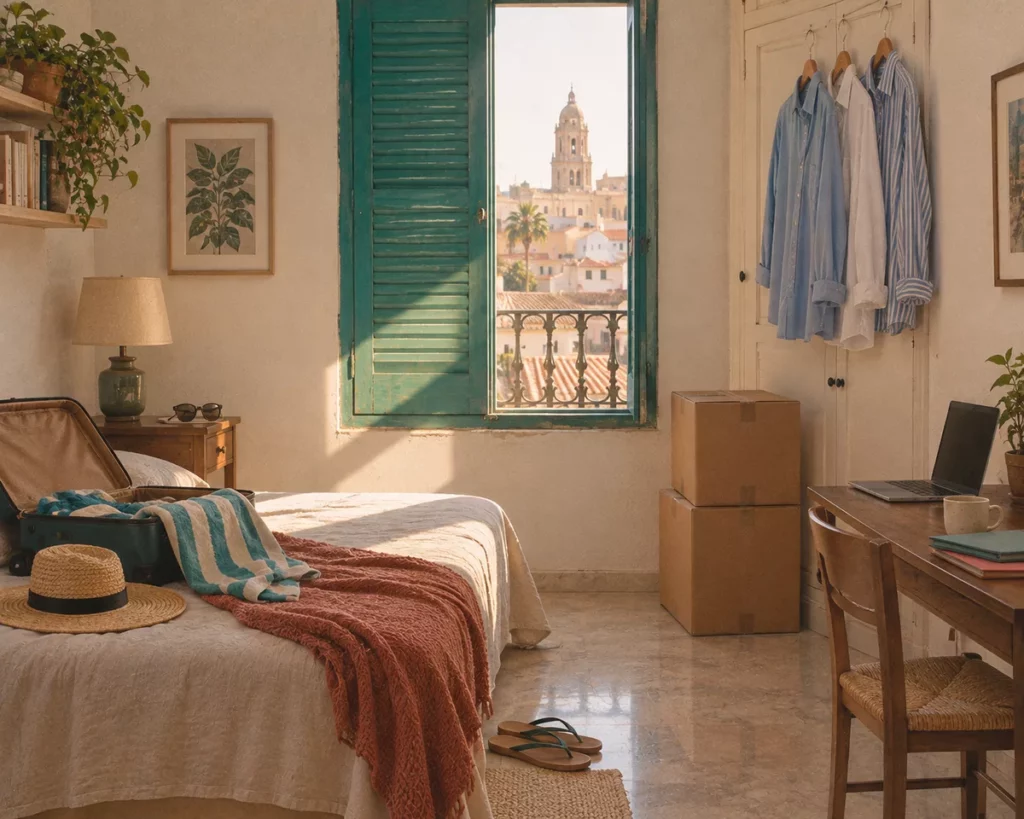
Let’s take an example. It is illustrative, with round assumptions: it is not a valuation of your property.
A two-bedroom flat of about 75 m² in Malaga city with a licence, compared with the same flat let mid-term:
| Holiday let | Mid-term rental | |
|---|---|---|
| Price | €140/night annual average | €1,500/month |
| Occupancy | 68% (about 248 nights) | 10.5 months a year |
| Annual revenue | ~€34,700 | ~€15,750 |
| VAT from 1 Dec 2026 | 10% on stays of up to 30 nights | Exempt (more than 30 nights) |
| Platform commissions | 15.5% (Airbnb host-only fee) | Low or none |
| Professional management | ~20% | ~10% |
| Utilities | Paid by you (~€2,400) | Usually included (~€1,200) |
| Approximate net before tax | ~€18,000 | ~€13,000 |
How the figures work: for the holiday let, occupancy is the figure INE (Spain’s National Statistics Institute) published for tourist apartments in the province in June 2026 (67.9%; the 12-month average is 65.5%), and the rate is an annual average: in July the city goes above €180 a night, but it drops a lot in winter.
If you keep your prices, the 10% VAT comes out of your margin (about €31,500 excluding VAT), and then you subtract platform fees, management and utilities. Cleaning is usually covered by the cleaning fee the guest pays.
For the mid-term rental, the starting point is the rental price in Malaga city, €16.7/m² in October 2026 according to idealista: about €1,250 a month for 75 m² on a long-term let.
A furnished flat with utilities included and contracts of a few months rents for more than that. From €15,750 you subtract management and utilities.
The holiday let comes out around 40% ahead, but that isn’t everything. A holiday let takes more work: guest turnover, prices that change every day, messages at any hour.
And from December you will need to issue a VAT invoice for every short stay. A mid-term rental is quieter, with less income and a different risk: a badly drafted contract can turn into a main-residence lease.
For the numbers on your own property, start with how much you can earn by renting out your property. And if you are weighing a holiday let against a long-term let, we compare them in long-term vs short-term rental in Spain.
In four situations:
At Your Malaga Host we manage holiday lets in Malaga and on the Costa del Sol.
If your property has a tourist licence, or can get one, we can tell you with real local data how much it would earn as a holiday let and whether it beats a mid-term rental.
We handle dynamic pricing, listings on several platforms, guests, cleaning and, from December, VAT invoicing too. You can see how we work on our vacation rental management in Malaga page.
Our articles are for information. For your specific case, or to check exactly what our service includes, contact us and we will answer your questions.
No. Mid-term rentals are governed by the Urban Leases Act, not by tourism law, and Malaga’s licence moratorium doesn’t affect them.
To be safe, use contracts of more than two months: in Andalusia, shorter stays can be treated as tourist stays.
More than 31 days and, as a general rule, no more than twelve months.
If it goes beyond that without a justifying reason, or more than two contracts are chained with the same tenant, it is treated as a main-residence lease from the first contract.
It loses its temporary nature and is treated as a main-residence lease from the day it was signed, with compulsory renewals. The reason must be genuine and provable, and proving it is the landlord’s job.
No. Residential rentals of more than 30 nights remain exempt. The 10% VAT that applies from 1 December 2026 covers furnished rentals of up to 30 nights, which is holiday-let territory.
In general, a holiday let earns considerably more: for a two-bedroom flat in the city, roughly double in gross revenue and about 40% more net.
But it requires a licence, which Malaga city no longer grants, and much more management. If your property has a licence or can get one, run the numbers before switching to mid-term.





Your Malaga Host
